

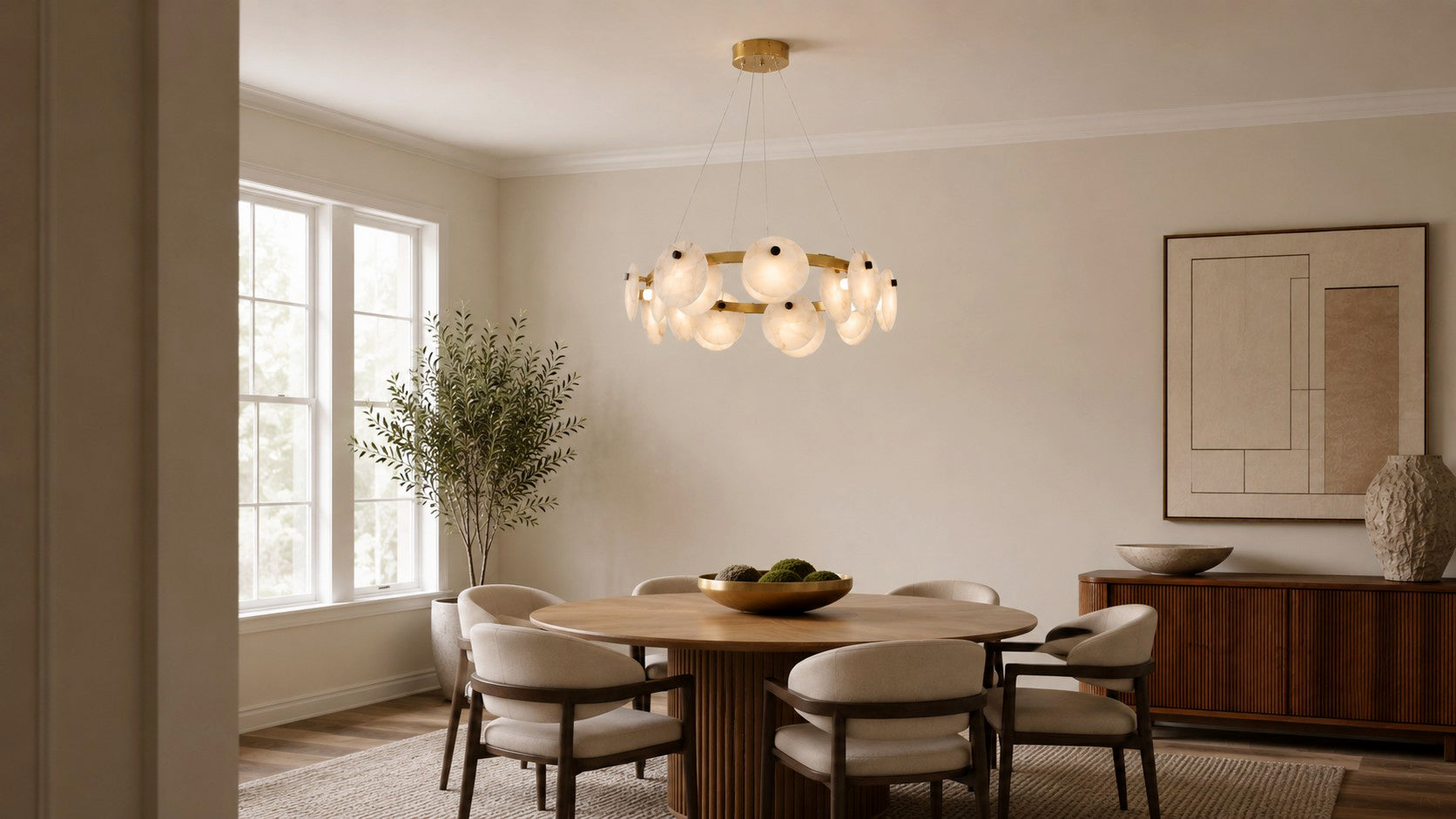
Vaulted-Ceiling Lighting Guide
How to Choose the Right Light Fixture for a Vaulted Ceiling
A vaulted ceiling gives a room beautiful height, but it can also make lighting decisions feel uncertain. A fixture that is too small may disappear into the open volume, while one that hangs at the wrong level can interrupt sightlines or feel disconnected from the furniture below. The best choice begins with the ceiling geometry, then balances mounting compatibility, fixture shape, scale, and the way the room is actually used.
Quick answer: Measure the ceiling's lowest and highest points, identify the mounting location and slope, and map the furniture below. Then choose a pendant, chandelier, or linear fixture whose canopy and suspension method are confirmed for that ceiling condition.

Start With the Ceiling Height, Pitch, and Room Layout
A vaulted ceiling is not one height. Measure the wall height at the low side, the height at the ridge, and the height at the exact location where the fixture will mount. The mounting-point height—not the peak elsewhere in the room—determines the available drop.
Next, record whether the ceiling is slightly sloped, steeply pitched, or formed by two planes meeting at a ridge. Then sketch the room layout, including walking paths, windows, doors, furniture, and the junction-box position.
- 1Measure the lowest, highest, and mounting-point ceiling heights.
- 2Record the approximate ceiling angle or pitch.
- 3Locate the junction box and note whether it sits on a slope or flat section.
- 4Measure the furniture group the fixture should visually anchor.
- 5Check every nearby sightline and walking path.

Pendant, Chandelier, or Linear Fixture: Which Works Best?
Pendant Light
Best for a focused area such as a breakfast table, compact entry, or kitchen island. A single pendant can fill a narrow vertical zone without visually spreading across the ceiling.
Chandelier
Best for a dining table, living-room grouping, or foyer that needs a stronger anchor. Open or tiered forms can occupy tall volume while preserving sightlines.
Linear Fixture
Best above a rectangular table or island. Its horizontal form relates to long furniture, but the suspension points must allow the body to hang level.
The decision should follow what sits below the fixture—not simply the height of the ceiling. Browse the Pendant Light collection or explore the Chandelier collection. Confirm the exact model's mounting requirements before ordering.

Check Sloped-Ceiling Compatibility Before You Buy
Do not assume every hanging fixture can mount on an angled ceiling. A flexible cord or chain may hang vertically, but the canopy and mounting hardware still need to sit correctly against the ceiling plane. A rigid stem may require a pivoting canopy, slope adapter, or a model specifically designed for angled installation.
| Component | What to Confirm | Why It Matters |
|---|---|---|
| Canopy | Can it mount on the stated ceiling angle? | A flat-only canopy may not sit correctly |
| Suspension | Cord, chain, fixed rod, or adjustable rod | Determines whether the fixture can hang vertically |
| Linear body | Independent cables or leveling adjustment | Helps the fixture remain horizontal |
| Overall drop | Minimum and maximum hanging height | Confirms that it fits the mounting point |
| Hardware | Product-specific parts or required adapter | Prevents compatibility assumptions |
How to Choose the Right Fixture Size and Hanging Height
Vaulted rooms often need more visual presence than flat-ceiling rooms of the same floor area, but larger should not mean filling every empty inch. Start with the furniture footprint, then consider the surrounding volume.
Choose width from the room and furniture
Over a dining table or island, keep the fixture visibly narrower than the surface below. In a living room or foyer, use the seating group, rug, stair opening, or entry axis as the visual boundary.
Calculate height from the lowest point
Preserve comfortable head clearance in open walking areas. Over a dining table or kitchen island, a common planning range is approximately 30 to 36 inches above the surface, adjusted for fixture scale, sightlines, and household needs.
Check the complete adjustable range
Review minimum and maximum hanging heights, including the canopy, fixture body, cord, chain, or rod. A long cord does not guarantee that a fixture can be shortened enough.

Match the Fixture to the Room and Furniture Below
Vaulted living room
Center the chandelier over the main seating group or rug rather than automatically using the geometric center of the ceiling.
Dining room
A round chandelier relates naturally to a round table, while a linear fixture often suits a rectangular table. Check seated and doorway sightlines.
Kitchen island
Use a linear fixture or balanced row of pendants. Multiple pendants may need different cord lengths to finish along one horizontal line.
Entryway or foyer
Use the doorway, staircase, or arrival axis to establish the centerline. Check the view from an upper landing when applicable.
Bedroom
A pendant or chandelier can align with the bed, but avoid placing a low fixture over an open route to a closet or doorway.

Common Vaulted-Ceiling Lighting Mistakes to Avoid
- Measuring only the ridge: The junction box may sit much lower.
- Assuming a cord means compatibility: The canopy must also suit the angle.
- Choosing only by size: Scale should relate to furniture and the occupied zone.
- Hanging near the roofline: The fixture can feel disconnected from the room.
- Blocking sightlines: Check views from seats, doors, stairs, and adjoining spaces.
- Ignoring leveling: Linear fixtures and pendant groups need an even finish.
- Centering on the ceiling: The furniture may use a different centerline.
- Skipping installation planning: Tall ceilings affect access and future maintenance.
Vaulted-Ceiling Fixture Checklist
- Lowest, highest, and mounting-point heights recorded
- Approximate ceiling pitch confirmed
- Canopy and suspension approved for the ceiling condition
- Minimum and maximum fixture drop checked
- Fixture width compared with furniture below
- Walking clearance and seated sightlines reviewed
- Linear fixture or pendant group can be leveled
- Installation and cleaning access considered
Bring the Ceiling and Room Into Balance
Explore pendants and chandeliers in a range of shapes and proportions, then confirm the selected fixture's dimensions and sloped-ceiling mounting requirements.
Share:
How to Choose Lighting for Low Ceilings Without Crowding the Room
Warm White vs. Soft White Lighting: Which Is Better for Each Room?