

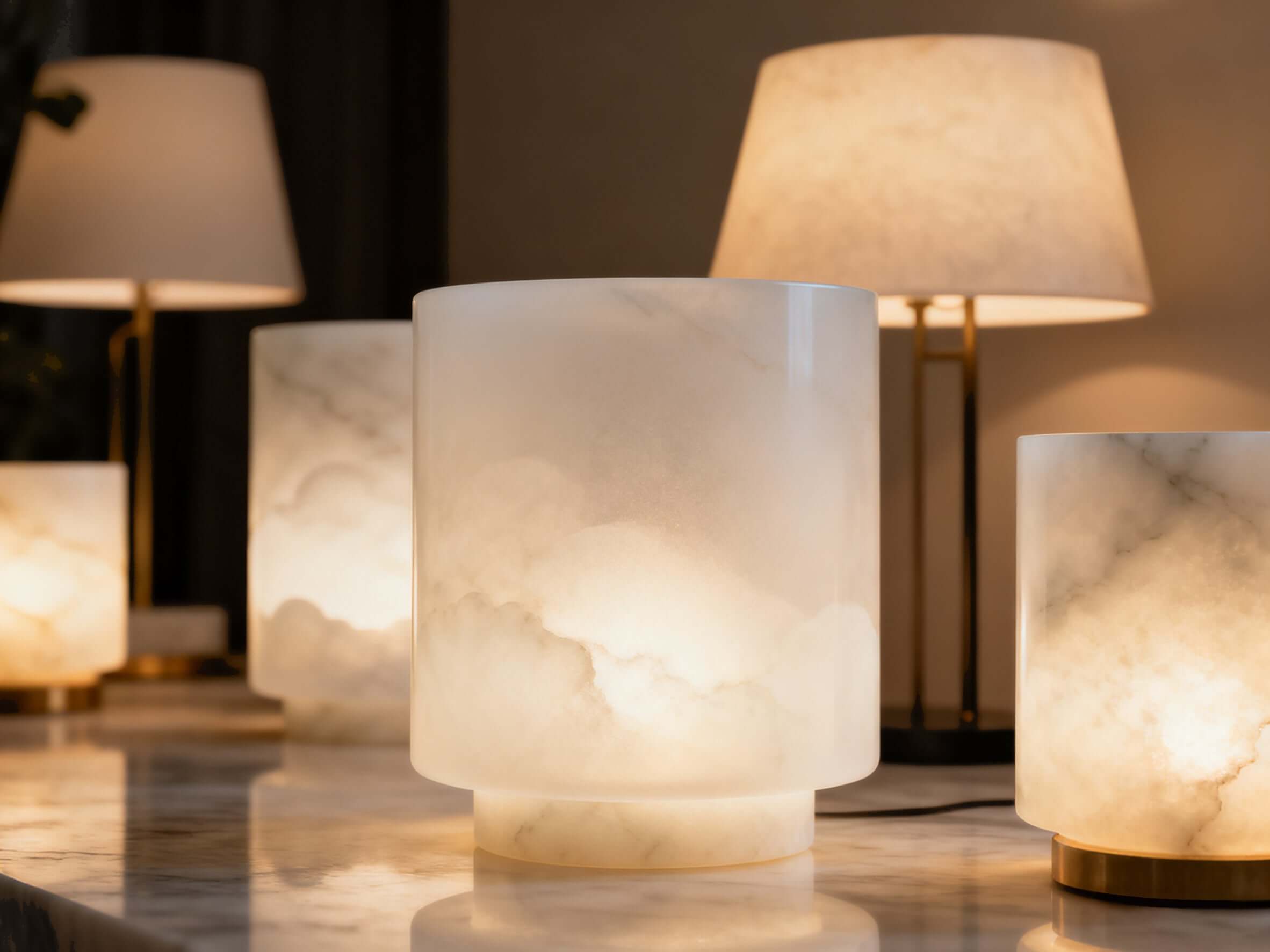
🏠 When people ask me what alabaster lighting really is, I always start with the material itself—because that’s where the magic happens
Alabaster is a natural stone, usually white or cream-toned, formed over thousands of years. Unlike marble or onyx, alabaster stays softly translucent, which makes it incredibly special for lighting. When light passes through it, the stone doesn’t glare or sparkle. Instead, it glows. That glow feels warm, calm, and almost candle-like.

✍️ The Beauty of Natural Veining (No Two Pieces Look the Same)
One thing designers love—and buyers often don’t realize at first—is that every alabaster piece looks different. The stone forms with natural veins, clouds, and subtle color variations. Some slabs show delicate gray lines, others display warmer honey tones.

This natural variation also explains why alabaster works so well in minimalist interiors. Even with a clean silhouette, the stone adds quiet visual depth.

🎨 Why Designers Keep Choosing Alabaster for Elegant Interiors
Designers don’t follow trends blindly. They care about longevity, mood, and versatility.
lt creates soft, flattering light. In dining rooms and bedrooms, harsh light ruins the atmosphere. Alabaster diffuses bulbs evenly, which makes faces look better and spaces feel more relaxed. That’s why high-end restaurants and boutique hotels often use alabaster pendants or sconces.

✍️ Designers trust its timeless appeal.
Alabaster appeared in European interiors centuries ago, long before modern lighting existed. Today’s designers reinterpret it with cleaner shapes and contemporary proportions. That combination of history and modern form keeps it relevant year after year.

🏷️ A Real-World Design Example
In one recent kitchen project I followed, a designer replaced standard glass pendants over a marble island with alabaster cylinders. The layout stayed exactly the same, but the space felt calmer and more refined immediately. The light no longer reflected sharply off countertops. Instead, it wrapped the room in a soft glow during evening hours.

That’s the power of alabaster. It doesn’t scream for attention. It quietly elevates everything around it.
🏡When I recommend alabaster lighting, I usually suggest it to people who want a piece they won’t feel tempted to replace in five years. It suits evolving interiors, changing wall colors, and new furniture styles without losing relevance.
When I'm choosing alabaster light fixtures, I usually pay attention to the following points:
1. Start with Alabaster Quality, Not the Shape
High-quality alabaster should look naturally translucent, not chalky or flat. In good product photos, I look for soft light passing through the stone, not harsh brightness or complete opacity. The surface should show organic veining rather than printed-looking patterns. Perfectly uniform “veins” often signal resin or composite materials masquerading as stone.

2. Craftsmanship Shows Up in the Small Details
Good alabaster lighting never relies on the stone alone. Craftsmanship makes the difference between “pretty” and “professional.”
I look closely at:
Edges: Clean, smooth edges signal careful cutting and finishing.
Seams: Minimal or invisible seams suggest skilled assembly.
Metal connections: The stone should meet the metal frame cleanly, without gaps or sloppy transitions.

3. Light Temperature Can Make or Break Alabaster, Alabaster reacts strongly to bulb choice.
I always recommend warm white (2700K–3000K) bulbs for alabaster pendants. Warm light enhances the stone’s natural glow and highlights its veining. Neutral or cool bulbs flatten the texture and make the stone look lifeless or gray.

🎁 Conclusion: A Warm Holiday Gift
In this fast-paced era, rossolighting persists in this slow and meticulous craftsmanship because we believe that true design is worth waiting for.
With Christmas and New Year approaching, we want to not only brighten your home but also warm your heart. We have prepared the warmest gift for you this year: use discount code 2025 to enjoy a 10% discount on your first purchase.
Share:
Soft Light, Natural Materials: The Story of a Rice Paper Lantern Chandelier
Soft Light, Natural Materials: The Story of a Rice Paper Lantern Chandelier