

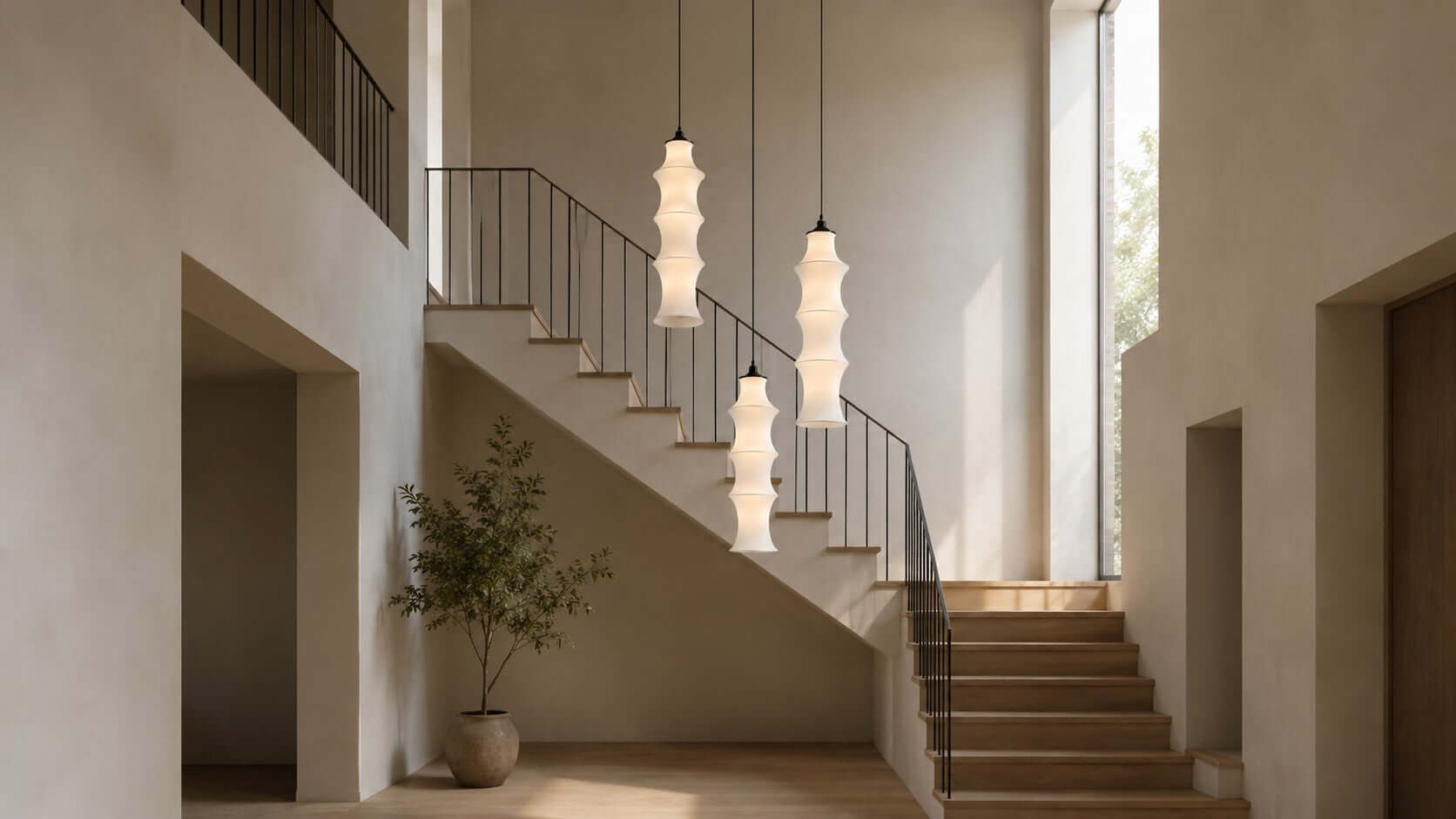
How to Choose Pendant Lighting for High Ceilings and Stairwells
A practical guide to proportion, vertical scale, light color, and placement—created for rooms that need more than an ordinary ceiling fixture.

Tall ceilings give a home volume, openness, and architectural presence. They also make lighting decisions more demanding. A fixture that feels perfectly balanced in a standard room can appear small, isolated, or visually disconnected when it is suspended in a two-story foyer or an open stairwell.
The answer is not always the widest or most elaborate chandelier. In many modern homes, a vertically composed pendant creates a clearer relationship between the ceiling and the occupied part of the room. Its shape fills the height without crowding the view, while a softly diffused shade helps the fixture feel calm rather than imposing.
Why High Ceilings Need a Different Lighting Approach
Volume changes visual scale
Fixture size is always relative. A pendant does not exist in isolation; it is read against ceiling height, nearby walls, windows, furniture, and open space. The more vertical volume a room has, the more likely a compact fixture is to feel detached from everything below it.
This does not mean every tall room needs an oversized chandelier. It means the fixture should have enough presence in at least one direction. In a narrow stairwell, vertical length may matter more than diameter. In a broad two-story foyer, both length and overall visual weight deserve attention.
Function and sightlines still matter
A beautiful pendant should support the way people move through the room. In open areas, the lowest point must leave suitable clearance below. Above a table or console, the furniture creates a natural boundary, but the fixture should still avoid blocking comfortable views across the space.
- Measure from the ceiling to the intended lowest point.
- Check nearby doors, windows, railings, and upper landings.
- View the proposed position from both lower and upper floors.
- Consider the fixture when lit and when switched off.
Why Vertical Pendant Lights Work So Well in Tall Rooms
A vertical pendant follows the direction the eye already wants to travel in a high-ceiling room. Instead of spreading broadly across the ceiling plane, it creates a visual line between the architecture above and the living area below. This can make a stairwell or foyer feel intentionally composed rather than simply empty.
The approach is especially useful when floor space is limited. A slender pendant can add height and character while preserving an open sightline through the room.
Broad chandeliers and long vertical pendants solve different design problems. One is not automatically better than the other. The right choice depends on the shape of the available space and the view you want to preserve.
| Fixture Direction | Often Works Well In | Visual Effect | Consider Before Choosing |
|---|---|---|---|
| Vertical Pendant | Stairwells, narrow foyers, tall corners, high-ceiling bedrooms | Draws the eye upward while keeping the footprint relatively focused | Available drop, lower clearance, and views from upper floors |
| Wide Chandelier | Broad dining rooms, large foyers, great rooms | Creates a strong horizontal centerpiece | Wall clearance, room width, table width, and visual density |
| Compact Pendant | Bedside areas, reading corners, smaller dining zones | Adds a focused accent without dominating the room | Whether the fixture will feel undersized in the full volume |

The Sculptural Structure of the Yndora Pendant Light
The Yndora Pendant Light is built around a tall, layered silhouette. Its stacked white silk shade gives the fixture a rhythmic form that can be read from a distance, while the narrow overall profile remains visually light.
This balance makes Yndora particularly relevant to high foyers, stairwells, bedrooms, and creative studios. The larger versions fill more vertical space; the smaller versions bring the same layered language to more intimate rooms.
What defines the design
- A white silk shade with gentle diffusion
- A stacked silhouette that emphasizes vertical movement
- Six listed size options, from compact to extended forms
- A choice of 3000K or 6000K light color
- Simple wall-switch control for everyday use

How a White Silk Shade Shapes the Atmosphere
A softer visual surface
Silk introduces a different character from clear glass or exposed metal. Rather than emphasizing a bare light source, the shade becomes the visible object. Light passing through the white layered form gives the pendant a softer presence and makes the silhouette easier to appreciate.
That quality suits rooms where lighting is expected to contribute to calmness as well as visibility: bedrooms, quiet living rooms, entry spaces, and creative studios.
Designed to work when unlit, too
A pendant remains part of the room throughout the day. Yndora’s white textile surface and sculptural outline allow it to act as a decorative form even when the light is off. Against warm neutral walls, wood, stone, or plaster-like finishes, the shade can feel integrated rather than overly contrasted.
For a more graphic result, place it against a deeper brown, charcoal, or muted olive backdrop. The pale shade will become a clearer focal point without requiring additional ornament.
Yndora Pendant Light Size Guide
Start with the architecture, not the product photo. Record the ceiling height, available fixture drop, width of the open area, and lowest acceptable point. Then compare those measurements with the full fixture dimensions listed below.
| Yndora Size | Visual Scale | Spaces to Consider | Planning Note |
|---|---|---|---|
| 2 Sections Ø 7.9″ × H 15.7″ |
Compact | Bedside areas, reading corners, small workspaces | Best treated as a focused accent rather than a large-room centerpiece |
| 3 Sections Ø 9.8″ × H 21.7″ |
Small to medium | Bedrooms, home offices, intimate dining areas | Check its scale against nearby furniture and ceiling height |
| 3 Sections Ø 15.7″ × H 31.5″ |
Medium | Dining areas, living rooms, moderate-height entry spaces | The wider diameter gives the three-section form more presence |
| 5 Sections Ø 13.8″ × H 49.2″ |
Tall | Stair landings, foyers, taller living spaces | Confirm the lowest point from every nearby walking route |
| 6 Sections Ø 13.8″ × H 55.9″ |
Extended and slender | Open stairwells and high-ceiling entryways | Useful where vertical impact matters more than width |
| 6 Sections Ø 15.7″ × H 63″ |
Largest listed option | Generous stairwells, tall foyers, large vertical zones | Mock up the full height and width before ordering |
Important: These room suggestions are general design guidance, not fixed installation rules. Ceiling construction, mounting location, walking clearance, local requirements, and the fixture’s complete installation information should all be reviewed before installation.
3000K vs. 6000K: Choosing the Right Light Color
Yndora is offered in 3000K and 6000K options. The difference affects the appearance of the shade, surrounding materials, and the overall mood of the room. Neither choice is universally correct; the decision should follow the atmosphere and existing lighting plan.
Warm White
3000K produces a warmer appearance that generally pairs well with wood, beige upholstery, warm stone, and relaxed residential interiors. Consider it for bedrooms, living rooms, dining areas, and entry spaces where a softer atmosphere is the priority.
Cool White
6000K has a distinctly cooler appearance. It may suit crisp, high-contrast interiors or spaces where the homeowner prefers a cooler visual tone. Compare it carefully with nearby lamps and ceiling lights so the open space does not contain conflicting light colors.
Simple decision: Choose 3000K when warmth and comfort lead the design. Consider 6000K when a noticeably cooler, brighter-looking color is intentional. In an open-plan home, coordinate the choice with other visible light sources.
Where a Vertical Silk Pendant Can Work Best
Stairwell
A stairwell lets the pendant be viewed from several elevations. Center the design within the open volume rather than judging its position from only one landing. Check the fixture from the ground floor, the stairs, and the upper hallway.
High Foyer
In a tall entry, a vertical pendant can bridge the distance between the ceiling and the arrival zone. Align it with the architectural center of the foyer or with a clear furniture anchor such as a centered entry table.
Bedroom
A compact Yndora size can replace a conventional bedside lamp when the room layout supports ceiling-hung lighting. Keep the lowest point clear of head movement and coordinate placement with the bed and nightstand.
Living or Dining Area
The wider three-section design can add sculptural softness without the visual density of a multi-arm chandelier. Place it where its vertical line relates to the furniture arrangement, and verify that the light does not interrupt conversation or primary views.
Creative Studio or Home Office
The layered shade adds a decorative focal point to a restrained workspace. Pair it with simple storage, tactile materials, and a clear work surface so the fixture remains part of a calm overall composition.


How to Style Yndora in a Warm Modern Home
The most convincing rooms repeat a small number of materials and colors. Because Yndora is white and softly textured, it can either blend into a pale neutral palette or stand out against a deeper background. The goal is not to match every object; it is to create enough visual connection that the pendant feels chosen for the room.
Avoid surrounding a sculptural pendant with too many competing decorative fixtures. If multiple light sources are visible, let them share a simple relationship through color, finish, or light temperature.
Natural Wood
White oak, ash, or walnut adds warmth and keeps the pale textile shade from feeling too stark.
Quiet Stone
Travertine, limestone, and softly veined stone support the fixture’s calm, tactile character.
Textured Fabric
Linen, bouclé, and wool repeat the softness of the silk shade without copying its exact surface.
Dark Contrast
Small amounts of black, deep brown, or muted bronze can give the white form a clearer outline.
What to Measure Before You Order
A few measurements can prevent the most common scale and placement problems. Record them on a simple elevation sketch so you can see the ceiling, fixture, floor, nearby furniture, and upper-level sightlines together.
Measure the full ceiling height
Measure from the finished floor to the ceiling at the exact proposed mounting location. Sloped or vaulted ceilings may vary across the room.
Define the lowest acceptable point
Account for people walking below, furniture placement, doors, stair movement, and views across the room. The available space between the ceiling and that lowest point is your working vertical zone.
Check the available width
Measure the distance to nearby walls, railings, windows, and architectural details. A narrow vertical pendant still needs breathing room around its full diameter.
Create a full-size visual mockup
Use paper, cardboard, painter’s tape, or a lightweight temporary outline to represent the fixture’s height and width. View it from every important approach before committing to a size.
Review product details before installation
Confirm the selected size and light color on the product page, and review the complete installation information for the actual mounting conditions in your home.
Pre-Purchase Checklist
- Ceiling height recorded
- Fixture diameter compared
- Available drop measured
- Walking clearance reviewed
- Upper-floor views checked
- 3000K or 6000K selected
- Nearby light colors compared
- Final product details reviewed
Frequently Asked Questions
Should a high ceiling always have a large chandelier?
No. A high ceiling needs a fixture with appropriate visual presence, but that presence can come from height, width, form, repetition, or material. A long vertical pendant can suit a narrow stairwell better than a wide chandelier.
Which Yndora size is best for a stairwell?
The answer depends on the stairwell’s ceiling height, open width, lower clearance, and views from nearby landings. The 5- and 6-section options provide the strongest vertical scale, but measurements should determine the final choice.
Is 3000K or 6000K better for a home?
3000K generally creates a warmer residential atmosphere, while 6000K appears distinctly cooler. Choose based on your preferred mood and the color of other visible light sources in the room.
Can a tall pendant work in a bedroom?
Yes, when its size and position suit the room. Smaller Yndora versions can be considered for bedside areas or quiet corners. Always check the lowest point, head movement, furniture placement, and available ceiling height.
How can I judge the fixture’s scale before ordering?
Make a full-size temporary outline using paper, cardboard, string, or painter’s tape. Compare the mockup from the entrance, seating area, stairs, and upper floor. This gives a more useful sense of scale than viewing dimensions on a screen alone.
Bring Soft Structure to a Tall, Open Space
Explore the Yndora Pendant Light in six listed sizes and choose between 3000K warm white or 6000K cool white.
Share:
From Stone to Glow: The Design Story of the Zoryn Wall Sconce
How High Should Pendant Lights Hang Above a Kitchen Island?