

Wall Lighting Guide
How High Should Wall Sconces Be? A Room-by-Room Placement Guide
A wall sconce can make a room feel calmer, more layered, and less cluttered—but a fixture placed too high, too low, or too close to furniture can create glare and awkward proportions. This guide gives you a practical starting height, then walks through bedrooms, living rooms, hallways, dining areas, entryways, stairs, and workspaces so you can adjust the placement to the people and furniture in your home.
Quick answer: For many indoor applications, start with the center of the wall sconce about 60 to 66 inches above the finished floor. Then adjust for the fixture's height, the room's ceiling, nearby furniture, and whether people will view it while standing or seated.

Wall Sconce Height by Room: Quick Chart
Use these dimensions as planning ranges, not rigid rules. The most useful measurement is usually from the finished floor—or the stair tread directly below—to the center of the fixture.
| Room or Location | Useful Starting Point | What to Check |
|---|---|---|
| Living room | 60–66 in. to fixture center | Seated sightlines, artwork, furniture height |
| Hallway | 60–66 in. to fixture center | Projection, door swings, even visual rhythm |
| Entryway | 60–66 in. to fixture center | Mirror, console, doorway, ceiling height |
| Dining room | 60–66 in. to fixture center | Seated glare, chair rail, sideboard placement |
| Bedside reading | About 4–6 in. above seated shoulder level | Bed height, headboard, reach, reading position |
| Staircase | 60–66 in. above the tread below | Consistent rising line and safe clearance |
| Desk or reading nook | Set from the user's seated position | Shoulder height, screen glare, task area |
These are design-planning guidelines. Existing junction boxes, local electrical requirements, fixture instructions, and household needs may change the final position. Confirm hardwired installation with a qualified electrician.
How to Measure Wall Sconce Height Correctly
The number printed on a plan often marks a junction box, while the visual center of a decorative wall lamp may sit above or below that point. Before wiring, review the fixture drawing and identify its backplate position, overall height, and projection from the wall.
- Start with the finished floor. Measure after accounting for the final flooring—not from an unfinished subfloor.
- Mark the fixture center. Use painter's tape to outline the complete silhouette on the wall.
- Check standing and seated views. Make sure the brightest part of the fixture is not directly in your normal line of sight.
- Test the projection. In a narrow passage, verify that the fixture will not feel intrusive or interfere with movement.
- Coordinate the pair. For two sconces, use a level and measure from a shared architectural reference.

How High Should Bedside Wall Lamps Be?
A bedside wall lamp should support reading while leaving the nightstand open. Because mattresses, frames, and headboards vary, measuring from the floor alone is less reliable here. Sit naturally against the pillows and begin with the main light area around 4 to 6 inches above your shoulder. This often keeps the light useful without placing it directly at eye level.
Also check whether you can reach the control position comfortably, whether the headboard blocks the fixture, and whether the sconce extends into the space where you get in and out of bed. For a pair, center each fixture over its nightstand or use the bed's centerline to create deliberate symmetry.
Small-bedroom tip: A small wall lamp with a shallow profile can free the nightstand visually. Keep enough space around it so the fixture still reads as an intentional design element rather than a crowded accessory.

Living Room Wall Sconce Placement
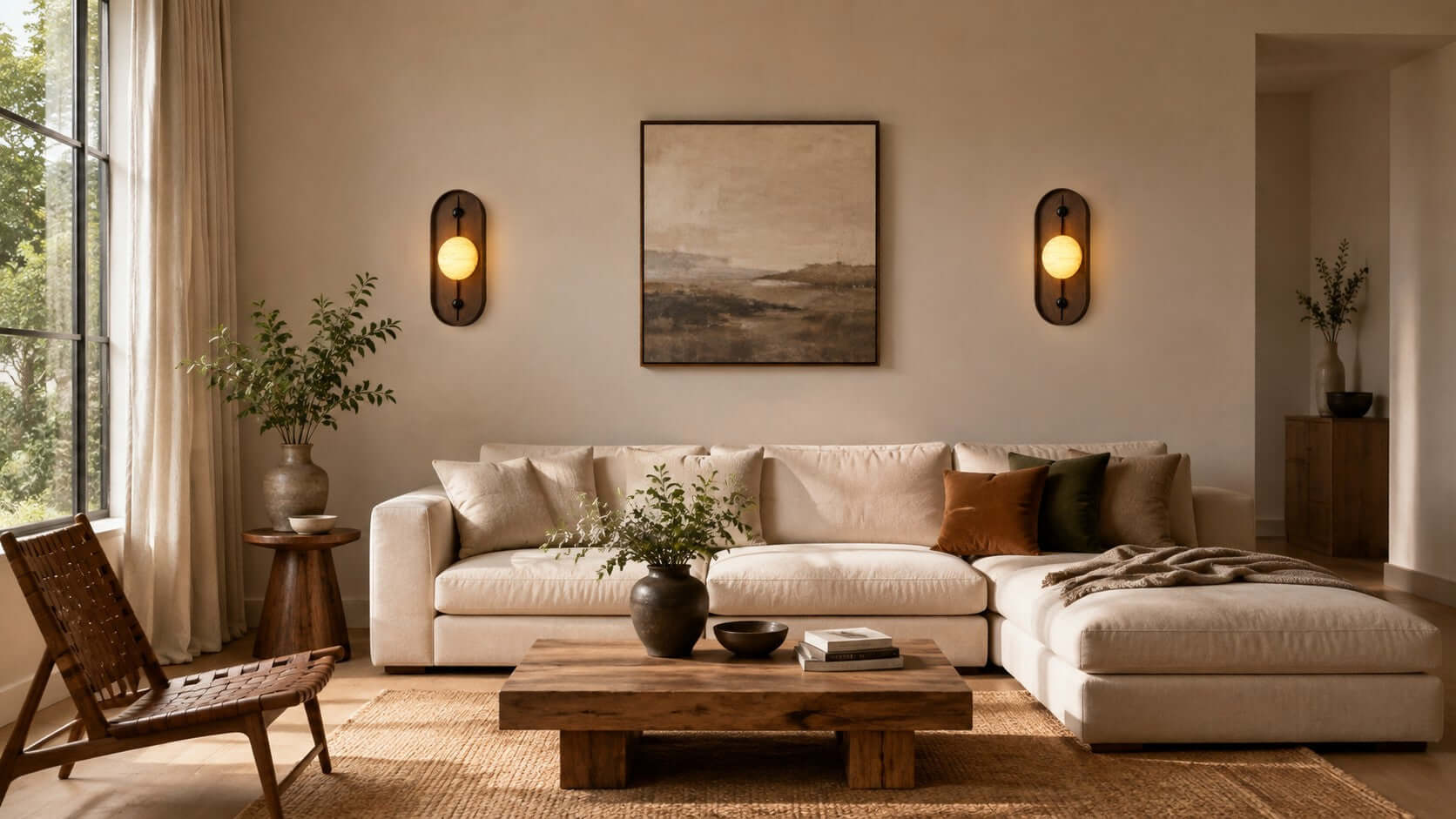
In a living room, 60 to 66 inches to the fixture center is a dependable starting range. Adjust it to the room's focal points: the top of a sofa, a fireplace surround, a bookcase, or artwork. If sconces flank a picture, mirror, or console, the composition should feel balanced as one group.
A sculptural or decorative wall lamp can provide a softer visual layer than overhead lighting alone. Before committing, sit on the sofa and confirm that the fixture does not create direct glare. In rooms with tall ceilings, a slightly higher position may feel more proportional, but it should still relate to the furniture below.
Hallway and Entryway Wall Sconce Height
For hallways, place the fixture center around 60 to 66 inches above the finished floor, then evaluate the wall length and ceiling height. Repeated sconces should follow a consistent centerline. Exact spacing depends on fixture output and architecture, so preview the rhythm with paper templates before installing multiple lights.
Projection is especially important in a corridor. A minimalist wall lamp with a restrained profile can help keep the path visually open. In an entryway, relate the sconce to the door, console, mirror, or artwork instead of allowing it to float without context.

Dining Room Wall Lamp Placement
Dining rooms are experienced mostly while seated, so glare matters as much as scale. Begin around 60 to 66 inches to the fixture center, then sit at the table and check the sightline. If the sconces sit above a sideboard, let the furniture anchor the composition and leave enough visual space between the tabletop, artwork, and fixtures.
Wall sconces work best as part of layered lighting rather than as a substitute for every other source. Pairing their gentle perimeter light with an appropriately placed ceiling fixture can give the room depth. Explore Rosso Lighting's Dining Room lighting collection when planning the complete room.

Staircase, Desk, and Reading-Nook Placement
Staircase wall sconces
On stairs, measure approximately 60 to 66 inches from the tread directly below each fixture—not from the lower landing. Arrange multiple sconces along a consistent rising line and keep their projection clear of the walking path. Stair geometry varies, so final layout is best coordinated on site with the installer.
Desk and reading-nook sconces
Task lighting should be positioned for the person using it. Sit at the desk or chair, mark your shoulder and eye level, and place the light so it reaches the work surface without shining into your eyes or reflecting strongly on a screen. An adjustable paper template is useful before a junction box is placed.
What About Bathroom Wall Sconces?
Beside a vanity mirror, eye-level placement is often the most comfortable starting point, commonly around 60 to 65 inches to the fixture center. However, bathroom suitability depends on the exact installation zone and the product's stated location rating. Only use a fixture specifically rated for the intended bathroom location; do not assume an indoor decorative sconce is appropriate near moisture.
Choosing the Right Wall Lamp for the Space
Height cannot fix a fixture that is out of scale. Consider the wall width, nearby furniture, overall fixture dimensions, and how far the sconce projects. Vertical forms can emphasize ceiling height, while compact silhouettes work well where wall area is limited. Materials and shape should also support the room's mood—whether Nordic modern, Japandi, or quietly luxurious.
Lurvian Wall Sconce
A vertical alabaster-and-wood composition offered in two sizes. Its 4.7-inch projection makes overall scale and passage clearance worth checking carefully.
View Lurvian →Zaytro Wall Sconce
An alabaster-and-brass design available in round and oval forms. The listed 1.6-inch projection can suit a clean, low-profile wall composition.
View Zaytro →Orlen Wall Sconce
A slender brass-and-alabaster form measuring 5.1 inches wide by 15.7 inches high, with a listed 3.9-inch projection.
View Orlen →Always review the current product page, dimensions, installation information, and stated location rating before purchase or installation.
Common Wall Sconce Placement Mistakes
- Using one height everywhere: Standing spaces and seated spaces create different sightlines.
- Measuring only to the junction box: An offset backplate can move the fixture's visual center.
- Ignoring projection: A beautiful light can still feel intrusive in a narrow hallway.
- Forgetting furniture: Bed frames, mirrors, doors, artwork, and cabinets all affect placement.
- Installing before testing: Painter's tape or a full-size paper template can reveal scale problems early.
- Assuming location suitability: Confirm the stated rating for the exact room and position.
Final Pre-Installation Checklist
- Confirm the fixture's overall height, width, projection, and backplate position.
- Mark the centerline and complete silhouette on the wall.
- Review the fixture while standing and while seated.
- Check door swings, headboards, mirrors, artwork, and walking clearance.
- Verify product instructions and suitability for the intended location.
- Have hardwired placement and installation confirmed by a qualified electrician.
Find a Wall Lamp That Fits Your Space
Explore sculptural, compact, and minimalist wall lighting for bedrooms, living spaces, dining rooms, entries, and hallways.
Shop Wall Lamps
Share:
How High Should Pendant Lights Hang Above a Kitchen Island?
How Many Pendant Lights Do You Need Over a Kitchen Island?