

Which Is Better for Entryway Lighting: Wall Sconces or Pendant Lights?
A practical guide to choosing the right lighting layer for your ceiling height, floor plan, daily routine, and decorating style.
 Visit Rosso Lighting →
Impressions
The entryway gives guests their first impression of a home, but it also needs to handle daily traffic without feeling crowded. I look for lighting that makes the space easy to navigate, complements the surrounding finishes, and feels welcoming after dark.
Wall sconces and pendant lights can both work well in an entrance. The right choice depends on ceiling height, room shape, furniture placement, natural light, and the atmosphere you want to create.
What Makes Entryway Lighting Different from Other Rooms?
 View Product →
An entryway connects the outdoors with the rest of the home. People need enough light to find keys, remove shoes, check a mirror, and move safely toward a hallway or staircase.
I begin by studying the architecture. I note the door swing, walking path, ceiling height, wall width, nearby stairs, and the position of any console table, mirror, or artwork. These details quickly show where a fixture can fit without creating an obstacle.
A narrow entrance needs lighting that keeps the center of the room open. A tall foyer often needs something that fills part of the vertical space. A windowless entry may also require stronger general illumination than one with a glass door or nearby windows.
I also view the room from outside the front door. A fixture may look properly centered from inside but feel awkward when guests first enter. Checking both viewpoints helps create a more intentional arrangement.
The Benefits of Wall Sconces in an Entryway
 View Product →
Wall sconces make sense when the ceiling feels low, the passage feels narrow, or the room already has decorative ceiling details. By directing light toward the walls, they can make a compact entrance feel wider and more dimensional. They also leave the main walking path clear.
I like using a matching pair on either side of a mirror, artwork, or console table. This arrangement creates balance and gives the eye a clear place to rest. It also provides useful light for checking your appearance before leaving home.
Perfect symmetry does not suit every entryway. In an uneven layout, one carefully placed sconce can brighten a dark corner or highlight a favorite piece of art. A single fixture often feels more natural beside a narrow console, coat hook area, or doorway.
Before selecting a wall light, check how far it extends into the room. The fixture should not catch a shoulder, interfere with a closet, or hide behind an open door. Use a cardboard template to test its height and width directly on the wall.
When Pendant Lights Make the Better Choice
 View Product →
Pendant lights work best when the entrance has enough ceiling height and needs a stronger focal point. They draw attention upward, helping a foyer feel more complete. In a tall or two-story space, a hanging fixture can visually connect the upper and lower levels.
A pendant also gives a square or open-plan entrance a clear center. If the room feels undefined, the fixture can establish where the entry begins before the layout transitions into a living or dining area.
I prefer a simple silhouette when the space already includes patterned flooring, detailed trim, colorful wallpaper, or bold artwork. If the architecture feels plain, a sculptural pendant can provide character without adding more furniture.
Scale deserves careful attention. A small pendant may disappear in a large foyer, while an oversized design can make a modest entry feel cramped. Test the planned position with string, painter's tape, or a lightweight paper outline before installation. The lowest point should maintain generous head clearance throughout the walking path.
Wall Sconces vs. Pendant Lights: Brightness, Space, and Style
 Visit the Store →
Wall sconces brighten the perimeter and work particularly well around mirrors, artwork, textured plaster, paneling, and architectural details. Pendant lights direct attention toward the center and usually contribute more to general illumination.
In a small entryway, one or two sconces may provide enough light while keeping the ceiling visually open. In a larger foyer, a pendant often creates a stronger foundation. However, the shape of the shade and the direction of the light matter as much as the fixture type.
I compare lumens rather than wattage when judging brightness. I also consider whether the shade directs light upward, downward, or in every direction. An enclosed shade creates a softer glow, while an open design may provide more direct illumination.
For most residential entries, I prefer warm white light around 2700K to 3000K. This range feels comfortable and complements wood, brass, natural stone, cream walls, and warm neutral paint colors. Cooler light may suit a crisp contemporary interior, but it can feel harsh when the rest of the home uses warm lighting.
The fixture should relate to the surrounding decor without matching everything exactly. Repeating one finish, curve, color, or material usually creates enough coordination. Mixed metals can still look intentional when they have similar visual weight and appear elsewhere in the room.
Wall Sconces
Best for perimeter light, lower ceilings, narrow passages, mirrors, artwork, and keeping the center open.
Pendant Lights
Best for central illumination, taller ceilings, open foyers, vertical scale, and a stronger visual focal point.
Can You Use Wall Sconces and Pendant Lights Together?
 Visit the Store →
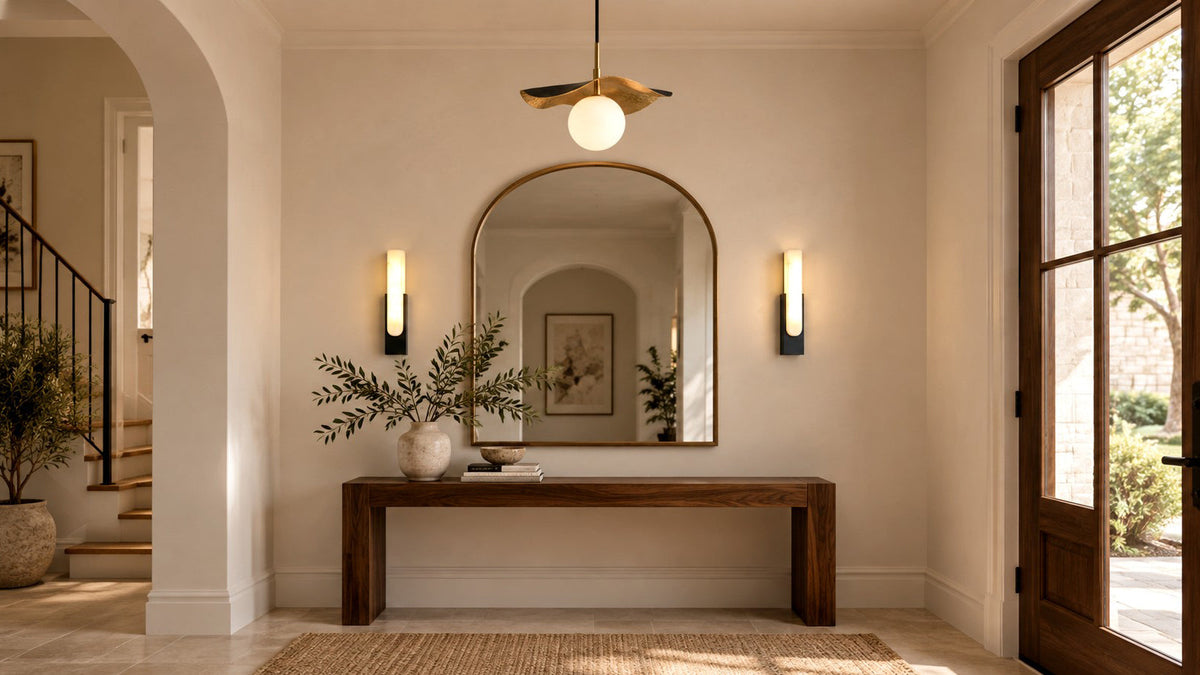
Yes. Combining both types often gives a medium or large foyer the most flexible lighting plan. I let the pendant act as the central feature, then use wall sconces to illuminate a mirror, console, artwork, or hallway transition.
This layered approach fills both the center and edges of the room without relying on one overly bright source. It also allows the entryway to feel different throughout the day.
The fixtures do not need to come from the same collection. I usually connect them through one shared element, such as a warm metal finish, rounded shape, pale stone texture, or matching color temperature.
Visual hierarchy matters. If the pendant has a bold sculptural form, simpler sconces will keep the entrance balanced. If the wall lights have strong decorative details, choose a quieter pendant that does not compete for attention.
Separate switches make the combination more practical. Turn on every layer when greeting guests or cleaning, then use only the sconces for a softer evening atmosphere. Confirm dimmer compatibility before choosing bulbs, LED drivers, and wall controls.
How to Choose the Best Lighting for Your Entryway
 Visit the Store →
Start with the room rather than the fixture. For a narrow entrance or a standard eight-foot ceiling, I generally favor wall sconces. For a tall, vaulted, or two-story foyer, I lean toward a pendant with an adjustable drop.
If the room has open ceiling space and a long furnished wall, combining the two may create the most balanced result. A pendant can define the center while sconces add depth around the perimeter.
Before ordering, check the ceiling height, door clearance, wall projection, fixture scale, brightness, color temperature, switch location, junction-box position, and location rating. A beautiful design will not work well if it blocks movement or leaves important areas in shadow.
View a full-size paper template from inside the home and from the front door. This simple test often catches a fixture that looks right online but feels too small, too low, or too close to another feature in the actual room.
Plan the electrical work before arranging artwork or ordering furniture. A licensed electrician can confirm the mounting location and wiring requirements, especially when you need a new junction box, separate switches, or additional wall fixtures.
There is no universal winner. Wall sconces usually suit compact entries, low ceilings, and decorative wall arrangements. Pendant lights make better use of height and create a clear focal point. Choose the option that fits the architecture first, then coordinate its shape, finish, and light quality with the rest of the home.
Share:
From Inspiration to Illumination: The Design Story Behind the Vornyx Pendant Lamp